When the Night Actually Ended: How America Lost Its Quiet Hours — and What That's Costing Us
When the Night Actually Ended: How America Lost Its Quiet Hours — and What That's Costing Us
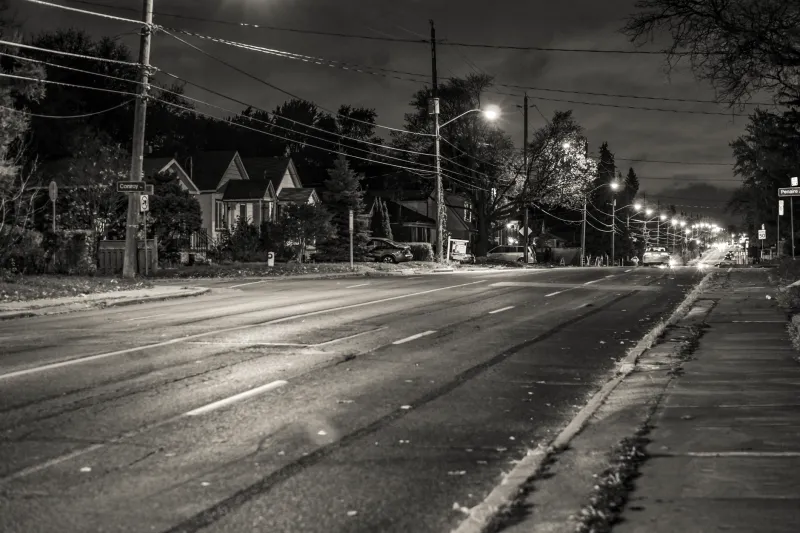
There's a particular kind of quiet that almost no American under forty has ever truly experienced. Not the quiet of a library or a movie theater, where silence is enforced and temporary. The quiet of a neighborhood at ten o'clock on a Wednesday in 1955 — where the only sounds were crickets, the occasional passing car, and maybe a dog two streets over. Where every window was dark. Where the whole world had, by some unspoken agreement, simply stopped.
That quiet is gone. And its disappearance is doing things to us that we're only beginning to measure.
How Darkness Used to Run the Clock
Before electricity became universal in American homes — a process that wasn't complete in rural areas until the 1940s and '50s — darkness was genuinely governing. When the sun went down, productive life largely stopped, because the alternatives were expensive candles, smoky oil lamps, or simply going to bed. Most Americans in the 19th century slept between nine and ten hours a night, not because they were lazy, but because there wasn't much else to do once the light was gone.
Even after electric light arrived, the cultural habits it replaced didn't vanish immediately. Neighborhoods in mid-century America still organized themselves around the rhythm of daylight. Businesses closed at six. Families ate dinner together because everyone was home. Children were called in when the streetlights came on — a cue so universal it became a cultural shorthand that parents still reference today, even though most kids wouldn't recognize the signal it once sent.
The night had rules. And those rules shaped everything: sleep, family structure, community behavior, and the basic human experience of time.
The Infrastructure of Always-On
The dismantling happened in stages. Television kept Americans up later through the 1950s and '60s, but it still had a stopping point — the national anthem played, the test pattern appeared, and that was that. The 24-hour news cycle arrived in 1980 with CNN, and suddenly information never slept. Convenience stores began staying open around the clock. Fast food chains followed. The internet, arriving in American homes through the 1990s, removed the last natural stopping point from the day.
Now consider what a typical American night actually contains in 2024. Delivery drivers are working. Warehouses are running. Customer service centers are staffed. Streaming platforms are serving content to viewers in every time zone simultaneously. Social media algorithms are optimized to keep you engaged at 2 a.m. just as effectively as at 2 p.m. Your phone — which most Americans now keep within arm's reach while they sleep — is receiving and transmitting data continuously, ready to alert you to anything deemed sufficiently urgent by an algorithm that has no concept of rest.
The boundary between day and night has not just blurred. It has effectively been erased.
What Darkness Actually Did for the Brain
Here's where the health consequences get concrete, and they're more serious than most people realize.
Human beings evolved with a circadian rhythm — an internal biological clock calibrated to the cycle of light and darkness. This clock governs not just sleep, but hormone production, immune function, metabolism, and cardiovascular health. Darkness triggers the release of melatonin, which signals the body to begin its nightly repair processes. Light — including the blue-spectrum light emitted by smartphones, tablets, and LED screens — suppresses melatonin production and tells the brain it's still daytime.
The American Sleep Association reports that between 50 and 70 million Americans currently have some form of sleep disorder. Average sleep duration has dropped by roughly 1.5 to 2 hours per night compared to a century ago. The CDC has declared insufficient sleep a public health epidemic. Research links chronic sleep deprivation to increased risk of obesity, diabetes, cardiovascular disease, depression, and cognitive decline — conditions that are all, not coincidentally, rising in prevalence.
Light pollution compounds the problem. The American Medical Association has formally recognized light pollution as a health hazard, noting that artificial outdoor lighting disrupts not just human sleep but entire ecosystems. In 1950, most Americans could see the Milky Way from their backyards. Today, roughly 80% of Americans live under skies too bright to see it. The stars didn't move. We lit them out.
 Photo: American Medical Association, via c8.alamy.com
 Photo: Milky Way, via wallpapercave.com
The Social Architecture of Night
Beyond the biology, something social has also been lost — something harder to quantify but no less real.
Night used to be a shared experience. When everyone in a neighborhood was home after dark, when commerce had closed and noise had faded, there was an implicit collective agreement that this time belonged to rest, to family, to private life. The structure of the night enforced boundaries that modern life has abandoned. Work ended because there was nowhere to work. Shopping ended because stores were closed. Social obligations ended because there was nowhere to go.
Now, the absence of those structures means that the decision to stop — to put the phone down, to close the laptop, to resist the pull of one more episode — must be made actively and repeatedly, against the current of an entire economy designed to prevent it. Saying no to nighttime engagement has become a discipline that previous generations never needed, because the world said no for them.
Parenting has changed accordingly. The "screens before bed" debate that occupies modern parents is entirely new — a problem that didn't exist when bedtime was simply bedtime, enforced by darkness and a lack of alternatives. Children's sleep patterns have shifted dramatically, with studies showing that American adolescents now sleep significantly less than their counterparts did fifty years ago, with measurable effects on mental health, academic performance, and physical development.
The Case for Getting the Night Back
None of this is an argument for returning to candles and oil lamps. Electric light is one of the most genuinely transformative improvements in human history, and the freedoms of the 24-hour world are real. Night shifts make hospitals and emergency services possible. Global communication requires people to be reachable across time zones. The always-on economy has genuine benefits that aren't worth dismissing.
But there's a growing movement — in sleep science, in public health, and in ordinary American households — pushing back against the assumption that more access is always better. Blue-light-blocking glasses, phone-free bedrooms, and "digital sunset" routines are all attempts to artificially recreate what darkness once provided for free: a clear signal that the day is over.
Some cities have begun revisiting their outdoor lighting ordinances. Sleep clinics are reporting record demand. "Sleep hygiene" has become a genuine wellness category, which is a remarkable thing when you consider that for most of human history, sleeping well wasn't a discipline. It was just what happened when night fell.
The quiet that once settled over American neighborhoods wasn't a limitation. It was a gift — one that arrived automatically, cost nothing, and did more for human health than any supplement on the market. We built an entire civilization to push it back. We're only now beginning to wonder whether that was entirely wise.