We Used to Sit With Death for Days. Now We Schedule It Between Meetings.
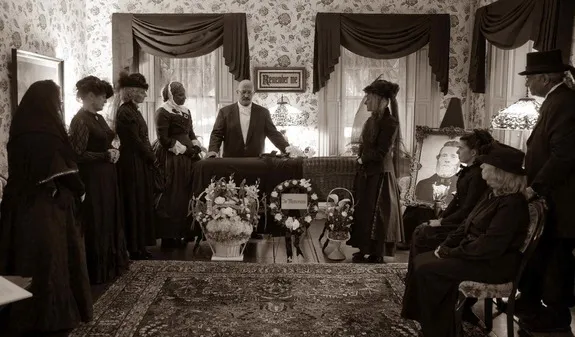
Photo: vintage funeral wake family gathering mourning historical, via history-list-prod.s3.amazonaws.com
In the 1880s, when someone died in an American household, the house itself became the center of the community's grief. The body was washed and dressed by family members — often women — and laid out in the front parlor on a cooling board. Neighbors arrived within hours. They came in shifts, sometimes through the night, sitting with the family, sharing food, telling stories about the person who had died. Children were present. Grief was witnessed. The whole neighborhood knew someone was gone, and the neighborhood showed up.
This could go on for two or three days before burial. And after the burial, it didn't stop. Formal mourning periods — weeks or months of wearing black, declining social invitations, and receiving visitors — were common well into the early twentieth century. Grief had a public face and a recognized timeline. Society made room for it.
Now consider the American experience of loss today. A family member dies on a Monday. By Wednesday, arrangements are made with a funeral home. There's a service on Friday — maybe an hour, maybe two. Saturday, people travel home. Monday, you're back at your desk. Human Resources gave you three days of bereavement leave, which is actually on the generous end of what most American employers offer.
The compression of grief is one of the strangest and least-examined transformations in American life.
How the Parlor Became the Living Room
The shift began, in part, with a piece of furniture — or rather, with the rebranding of a room. In the early twentieth century, American home design featured a "parlor," a formal front room used primarily for receiving guests and, when necessary, displaying the dead. As the century progressed and funeral homes became more common, taking over the practical work of preparing and housing bodies, the parlor lost its original purpose. Home decorating magazines of the 1910s and 1920s began calling it the "living room" — a name that was, intentionally or not, a quiet rejection of death's place in domestic life.
The professionalization of death care accelerated through the mid-twentieth century. Embalming became standard. Funeral homes became sophisticated businesses. The body moved out of the home and into a professional setting, and with it went much of the community's direct encounter with physical death. Death became something that happened elsewhere, managed by experts, contained and sanitized before most people saw it.
This wasn't purely a commercial development. Urbanization played a role — apartment living doesn't lend itself to multi-day home wakes. Declining extended family networks meant fewer people to share the labor of grief. World War II, which killed hundreds of thousands of Americans and sent bodies home in closed coffins with government-managed ceremonies, also shaped the culture's relationship with death toward efficiency and containment.
The Three-Day Wake and What It Actually Did
It's easy to romanticize older mourning practices without acknowledging how hard they were. Sitting with a body in your home for two days, in an era before modern embalming and climate control, was not a gentle experience. Formal mourning periods could be genuinely suffocating, particularly for women, who bore the heaviest social obligations.
But those extended rituals served real psychological and social functions that we've largely discarded without replacement.
The multi-day wake gave the bereaved something to do during the most disorienting hours of acute grief. Hosting, receiving guests, accepting food, telling stories — these tasks structured time that would otherwise be shapeless and overwhelming. Psychologists who study grief now recognize that activity and social connection in the immediate aftermath of loss are genuinely protective. The old wake, for all its difficulty, delivered exactly that.
The extended mourning period — those weeks of wearing black and withdrawing from social life — also communicated something important to the community: this person is not okay right now, and they need accommodation. It gave grief a visible marker. You didn't have to explain yourself at every social interaction. Everyone could see that you were in mourning, and social expectations adjusted accordingly.
Today, that accommodation has largely disappeared. Three days of bereavement leave — the federal standard for most employers, where one exists at all — covers the logistics of death but not its emotional aftermath. The expectation that a person returns to full professional functioning within a week of losing a parent or a spouse is, by any historical or cross-cultural standard, extraordinarily demanding.
What We're Calling Resilience
There's a word that gets used a lot in modern discussions of grief: resilience. We praise people for returning to normal quickly. We admire those who seem to hold it together. The person who's back at work in four days, keeping up with their inbox, making the kids' lunches — they're described as strong.
But grief researchers have complicated this picture significantly. The work of psychologists like George Bonanno has shown that some people do genuinely recover quickly from loss without long-term harm. But for many others, the appearance of rapid recovery masks grief that resurfaces later — sometimes months or years down the line, in ways that are harder to recognize and treat precisely because they've been disconnected from their cause.
The cultural pressure to move on quickly doesn't make grief shorter. It makes grief quieter. And quiet grief is harder to support, harder to share, and harder to heal.
The Slow Return of Ritual
There are signs that American culture is beginning to reckon with what it gave up. Death cafés — casual community gatherings where people discuss death and dying over coffee — have spread to hundreds of American cities since the concept arrived from the UK around 2012. Death doulas, who help families navigate the dying process and immediate aftermath, are a growing profession. Online grief communities have emerged to fill some of the communal support role that neighborhoods once provided in person.
Some employers have begun extending bereavement leave — a handful now offer two weeks or more. The conversation about whether three days is an appropriate cultural response to the death of someone you love is at least beginning to happen.
None of this is a return to the three-day wake. That's not coming back, and it probably shouldn't. But the impulse behind it — the idea that death deserves more than a long weekend, that grief requires community and time and visible acknowledgment — that impulse wasn't wrong.
We just decided, somewhere in the rush of the twentieth century, that we couldn't afford it. We're still paying for that decision.