When News Arrived by Horseback: How Americans Lived in the Age of Yesterday's Headlines
The Morning Ritual That Shaped a Nation
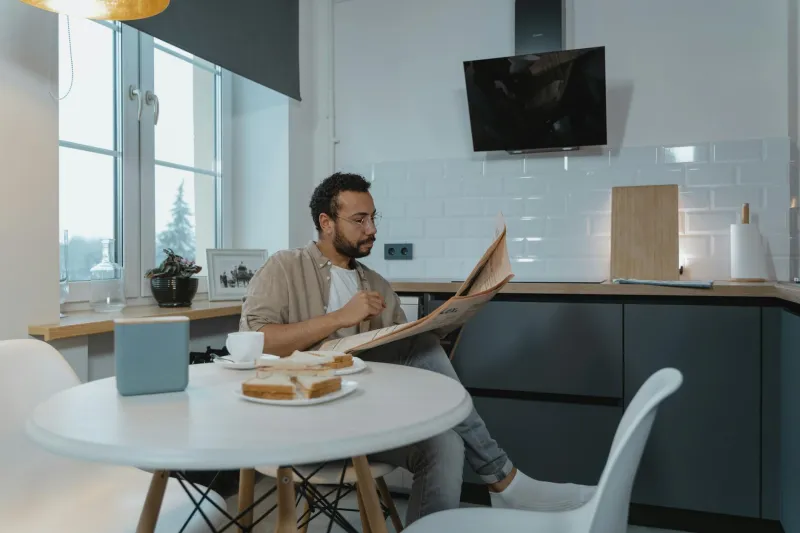
Every morning at 6:30 AM, Harold Peterson would step onto his front porch in suburban Cleveland, coffee in hand, and scan the driveway for that familiar folded rectangle. The Cleveland Plain Dealer wasn't just his newspaper—it was his window to the world, his primary source of truth, and often the only news he'd consume all day.
This scene played out in millions of American homes throughout the mid-20th century. The morning paper wasn't just information delivery; it was a sacred ritual that structured entire communities around shared knowledge and common understanding.
Today, we receive more news notifications in a single hour than Harold got in an entire week. But something profound was lost when we traded the deliberate pace of print journalism for the frantic speed of digital feeds.
When Yesterday's News Was Actually News
In 1960, if a major event happened in Washington D.C. on a Tuesday, most Americans wouldn't read about it until Wednesday morning—if they were lucky. Small-town newspapers might not cover it until Thursday or Friday. International news could take days or even weeks to reach American breakfast tables.
The assassination of President Kennedy in 1963 marked one of the last times Americans experienced truly breaking news the old way. Radio and television interrupted regular programming, but for detailed coverage and analysis, people still waited for the next day's newspaper. Families saved those papers as historical documents, understanding they were witnessing history unfold in slow motion.
Contrast this with 2023, when news of Queen Elizabeth II's death reached American smartphones within minutes. Twitter users were sharing the news before major television networks had confirmed it. The entire cycle from event to global awareness compressed from hours into seconds.
The Trusted Voice in Every Living Room
Before the internet fractured America into information tribes, most communities rallied around a handful of trusted sources. The local newspaper editor wasn't just a journalist—they were a community pillar, someone you might see at the grocery store or your kid's baseball game.
Walter Cronkite didn't just read the news; he was "the most trusted man in America" because families invited him into their living rooms every evening at the same time. When Cronkite declared the Vietnam War unwinnable, President Johnson reportedly said, "If I've lost Cronkite, I've lost Middle America."
This concentrated trust seems almost quaint now. Today's Americans navigate dozens of news sources daily, from CNN push notifications to TikTok videos to Facebook posts from high school friends. We've gained access to infinite perspectives but lost the shared foundation of common facts that once held communities together.
The Physical Relationship with Information
Reading the newspaper was a full-body experience. You unfolded it with both hands, felt the ink occasionally smudge your fingers, and heard the satisfying rustle as you turned each page. The Sunday paper was an event—thick enough to last hours, heavy enough to require both arms to carry it inside.
Families developed elaborate sharing protocols. Dad got the front page and sports first, Mom claimed the local section and features, teenagers fought over the comics, and everyone saved the crossword for last. The newspaper physically passed through the household, creating a shared experience that today's individual smartphone screens can't replicate.
The classified ads alone represented an entire economy of human connection. People hunted for jobs, apartments, and used cars by scanning tiny print with a magnifying glass. Dating happened through personal ads that cost money to place and required genuine creativity to stand out in 25 words or less.
When Patience Was a Virtue, Not a Weakness
Perhaps most remarkably, Americans of the pre-internet era were comfortable not knowing things immediately. If you wondered about a movie star's age or a historical fact during dinner conversation, you might look it up later in the encyclopedia—or you might just let it go.
This tolerance for uncertainty created space for deeper thinking. Without instant access to opposing viewpoints and fact-checks, people spent more time forming their own opinions before seeking validation or contradiction. Conversations could unfold without someone immediately pulling out a phone to settle every dispute.
The weekly news magazines—Time, Newsweek, U.S. News & World Report—specialized in analysis and context rather than breaking news. They assumed readers wanted to understand why events mattered, not just what happened.
The Price of Everything, Everywhere, All at Once
Today's information abundance comes with hidden costs that Harold Peterson never faced. We're more informed about global events than any generation in history, yet polls consistently show Americans feel more anxious and divided than ever.
The algorithmic curation that determines what news we see has replaced the editorial judgment of professional journalists. Instead of a trusted editor deciding what deserved front-page treatment, artificial intelligence analyzes our clicking patterns to serve us more of what we've already shown interest in.
We've gained real-time access to the entire world's information but lost the shared experience of processing major events together. Where once Americans gathered around radios during Pearl Harbor or television sets during the moon landing, today's major news breaks into millions of individual smartphone screens, each person receiving slightly different versions of reality.
What We Lost When We Gained Everything
The transformation from print-dominated news consumption to digital information overload represents more than technological progress—it's a fundamental shift in how Americans understand their place in the world.
We traded the patience of morning coffee with the newspaper for the anxiety of constant connectivity. We exchanged trusted community voices for personalized echo chambers. We swapped the ritual of shared information consumption for the chaos of individually curated news feeds.
Yet we've also gained unprecedented access to diverse perspectives, real-time global awareness, and the ability to fact-check claims instantly. The challenge isn't returning to Harold Peterson's world—it's figuring out how to preserve the best aspects of deliberate, community-centered news consumption while embracing the benefits of our hyperconnected age.
The next time your phone buzzes with a breaking news alert, remember Harold on his front porch, waiting patiently for yesterday's news to arrive with the morning paper. In our rush toward instant information, we might have left something valuable behind in that slower, more deliberate world.