When Breaking Your Leg Meant Breaking Your Life: The Terrifying Reality of Bone Injuries Before Modern Medicine
The Sound That Changed Everything
Imagine hearing your ankle snap while stepping off a curb in 1870s New York. That crack wouldn't just signal a painful injury—it would announce the potential end of your livelihood, your independence, and quite possibly your life. In an era when a carpenter's broken wrist meant permanent unemployment and a farmer's fractured leg could bankrupt an entire family, bone injuries carried consequences that modern Americans can barely comprehend.
Today, we schedule knee replacements like routine maintenance and walk out of hospitals hours after complex fracture repairs. But this transformation from medical catastrophe to minor inconvenience represents one of the most dramatic evolutions in American healthcare—a journey from sawdust-covered amputation tables to precision robotics that would astound our ancestors.
When Bones Broke, Lives Shattered
In 1870, the average American worker earned about $300 per year. A serious fracture didn't just mean medical expenses—it meant months or years without income. Factory workers who broke their arms were simply replaced. Farmers who couldn't walk lost their harvests. There was no workers' compensation, no disability insurance, and certainly no guarantee you'd ever work again.
Dr. Samuel Gross, one of America's leading surgeons in the 1870s, wrote matter-of-factly about patients who "preferred death to the mutilation" of amputation. This wasn't dramatic language—it was clinical observation. When infection set in after a compound fracture, which it almost inevitably did, sawing off the limb was often the only option to save the patient's life.
The tools of the trade were brutally simple: bone saws, leather straps for restraint, and whiskey or laudanum for pain relief. Operating rooms were often just regular rooms with good lighting. Surgeons operated in their street clothes, and the concept of sterile technique wouldn't arrive in America until the 1890s.
The Slow Revolution Begins
The transformation began during the Civil War, when military surgeons were forced to innovate or watch soldiers die by the thousands. Dr. Nathan Smith Davis, working in Union field hospitals, began experimenting with better splinting techniques and wound care. But even these improvements were crude by today's standards.
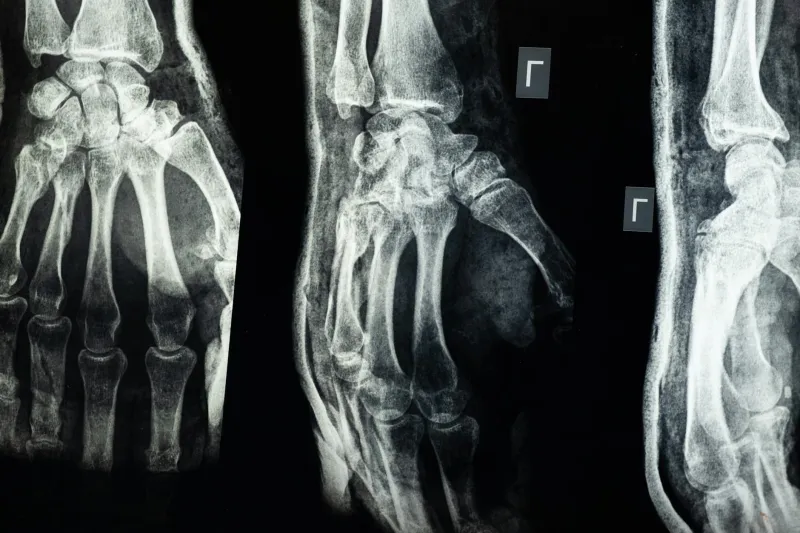
The real breakthrough came in the 1890s with the arrival of X-ray technology. For the first time in human history, doctors could see inside the body without cutting it open. Dr. Harvey Cushing at Johns Hopkins described the first X-ray images as "miraculous"—and they were. Suddenly, physicians could diagnose fractures accurately, see how bones were healing, and plan treatments with unprecedented precision.
But X-rays were just the beginning. The development of antiseptic surgery by Joseph Lister revolutionized infection control. Anesthesia evolved from crude ether inhalation to sophisticated pain management. By 1920, orthopedic surgery was becoming a legitimate medical specialty rather than a desperate last resort.
The Modern Miracle
Fast-forward to today, and the contrast is staggering. A compound fracture that would have meant certain amputation in 1870 is now routinely repaired with titanium plates and screws. Hip replacements—unimaginable a century ago—are performed 450,000 times annually in the United States. Patients walk the same day.
Consider what happened to President Reagan in 1981 when he broke his hip at age 78. He was back to his normal activities within weeks. In 1881, a 78-year-old with the same injury would likely never walk again, if they survived at all.
Today's orthopedic arsenal reads like science fiction to previous generations: arthroscopic surgery performed through tiny incisions, computer-guided joint replacements, and bone grafts that stimulate natural healing. Sports medicine has evolved to the point where athletes routinely return from injuries that would have ended careers just decades ago.
The Numbers Tell the Story
The statistics reveal just how dramatically things have changed. In 1900, the amputation rate for compound fractures exceeded 50%. Today, it's less than 2%. A century ago, the average hospital stay for a broken leg was 6-8 weeks. Now, many fracture repairs are outpatient procedures.
Even more striking is the survival rate. Orthopedic infections, once fatal in 30-40% of cases, now have mortality rates below 1% thanks to antibiotics and advanced surgical techniques. What was once a medical emergency requiring months of recovery is now often handled with same-day surgery and a few weeks of physical therapy.
Living in the Future
Perhaps most remarkably, we've moved beyond just fixing broken bones to preventing them entirely. Osteoporosis treatments, joint preservation techniques, and preventive orthopedics help Americans maintain mobility well into their 90s. Our ancestors would be amazed not just by our ability to repair catastrophic injuries, but by our capacity to help people avoid them altogether.
The next time you see someone walking confidently on an artificial knee or returning to sports after ACL surgery, remember: you're witnessing what would have seemed like resurrection to Americans just five generations ago. We've evolved from a world where broken bones broke lives to one where orthopedic miracles happen in hospital parking lots every single day.
That transformation didn't happen overnight—it took 150 years of innovation, dedication, and countless small breakthroughs. But the result is a medical revolution that has fundamentally changed what it means to be human in America.