From Deathbed to Delivery Room: How America Transformed Its Most Dangerous Moment Into Its Safest
Your great-grandmother faced a terrifying reality that's almost impossible to imagine today: every pregnancy was potentially a death sentence. In the early 1900s, roughly 600 to 900 American women died for every 100,000 births. To put that in perspective, if today's maternal mortality rates matched those of 1915, we'd lose over 20,000 mothers every year instead of the current 700.
Back then, the phrase "died in childbirth" wasn't a historical curiosity—it was a genuine fear that haunted every expectant mother and their families.
When Home Was the Most Dangerous Place
In 1900, virtually every American baby was born at home. Not by choice, but because hospitals were seen as places where poor people went to die. Middle-class and wealthy families considered home births not just preferable, but safer. They couldn't have been more wrong.
The typical birth scene looked nothing like today's carefully controlled environment. Picture a bedroom with no running water, where the attending midwife or doctor arrived with unwashed hands and unsterilized instruments. There were no antibiotics, no blood banks, and certainly no emergency cesarean sections. If something went wrong—and it often did—there was virtually nothing anyone could do except pray.
Infection was the silent killer. Puerperal sepsis, or "childbed fever," claimed thousands of lives annually. Women would deliver successfully, only to develop a fever days later that would kill them within a week. The very people trying to help—doctors and midwives—unknowingly carried deadly bacteria from patient to patient.
The Germ Theory Revolution
Everything began to change when American medicine finally embraced what European doctors had been proving for decades: germs cause disease. Dr. Ignaz Semmelweis had demonstrated in the 1840s that handwashing dramatically reduced maternal deaths, but American physicians were slow to adopt these "foreign" ideas.
By the 1920s, the tide was turning. Hospitals began implementing basic sanitation practices. Doctors started washing their hands and sterilizing instruments. It sounds absurdly simple now, but these basic hygiene measures immediately began saving lives.
The real transformation came with the mass migration from home to hospital births. In 1938, about half of American babies were still born at home. By 1955, that number had plummeted to just 1%. This wasn't just a change in location—it was a complete reimagining of childbirth as a medical event requiring professional oversight.
When Science Met Motherhood
The mid-20th century brought innovations that would have seemed like magic to earlier generations. Blood typing and storage meant that hemorrhaging mothers could receive life-saving transfusions instead of bleeding to death. Antibiotics turned once-fatal infections into minor inconveniences.
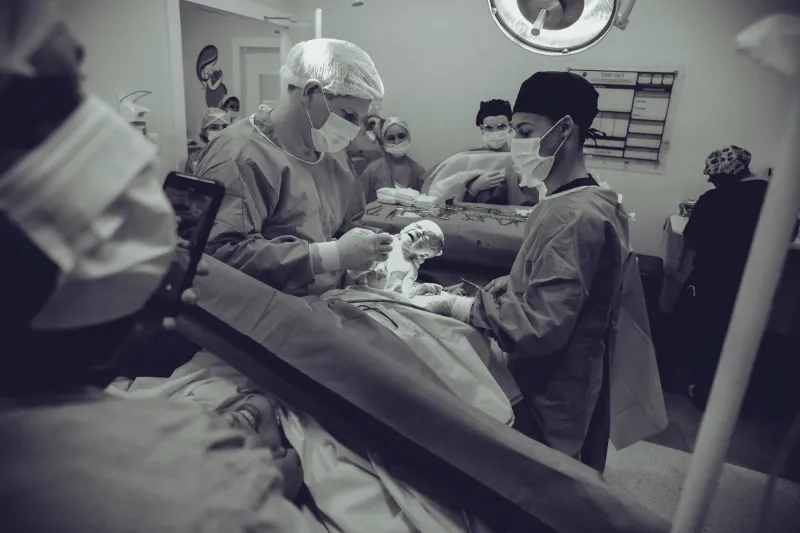
Perhaps most importantly, cesarean sections evolved from a desperate last resort performed only after maternal death to a routine procedure that could save both mother and baby. In the early 1900s, a C-section was essentially a death sentence. Today, about one in three American babies arrives this way, with maternal mortality rates barely higher than vaginal delivery.
Anesthesia transformed the experience entirely. Your great-grandmother endured hours of excruciating labor with perhaps a shot of whiskey for pain relief. Modern mothers can choose from epidurals, spinal blocks, and other pain management options that would have seemed miraculous a century ago.
The Numbers Tell the Story
The statistics are staggering. In 1915, maternal mortality in the United States peaked at around 900 deaths per 100,000 live births. Today, that number hovers around 17—and even that's considered too high by international standards. We've reduced maternal mortality by more than 98%.
To understand this improvement, consider that childbirth today is statistically safer than:
- Getting your appendix removed
- Having gallbladder surgery
- Even some dental procedures
What once ranked among the leading causes of death for American women now barely registers in mortality statistics.
The Modern Miracle
Walk into any American delivery room today and witness what would have looked like science fiction to our ancestors. Fetal monitors track the baby's heartbeat continuously. Ultrasounds reveal problems months before birth. High-risk pregnancies that would have been automatic death sentences now have survival rates above 90%.
Neonatal intensive care units save babies born months premature—infants who wouldn't have survived hours in 1915 now grow up to live completely normal lives. The collaboration between obstetricians, anesthesiologists, nurses, and specialists creates a safety net that catches virtually every complication before it becomes catastrophic.
What Changed Everything
The transformation wasn't due to any single breakthrough but rather the convergence of multiple advances: antiseptic practices, hospital-based care, blood banking, antibiotics, improved surgical techniques, and better understanding of pregnancy complications.
Just as importantly, American society began viewing childbirth as a medical event deserving professional attention rather than a natural process best left to traditional midwives and family members.
Today's expectant mothers worry about nursery colors and baby names—concerns that would have seemed luxurious to women who first had to survive the delivery. The evolution from life-threatening ordeal to routine medical procedure represents one of the most dramatic improvements in human experience, transforming what was once America's most dangerous moment into its safest.